A failing flat roof forces a decision most people would rather not have to make. The options are broader than they used to be, and the right answer is not always obvious — particularly when comparing single-ply membrane against metal roofing systems.
Both are legitimate, professionally specified solutions. They are not interchangeable. The better choice depends on the specific project, and this guide sets out the key differences clearly so you can make it with a realistic picture of what each system offers.
What the comparison actually involves
Single-ply membrane and metal roofing are both used on flat and low-pitched roofs, on new builds and replacement projects alike. Both, when correctly specified and installed, will perform reliably for years. The differences come down to lifespan, upfront cost, aesthetic result, and the nature of the project.
This is not a choice between a good system and a bad one. Single-ply is a serious roofing product used on schools, hospitals, commercial buildings, and thousands of residential extensions across the UK. Metal flat roofing sits at the higher end of the performance and cost spectrum. The decision is about fit, not quality.
Single-ply membrane
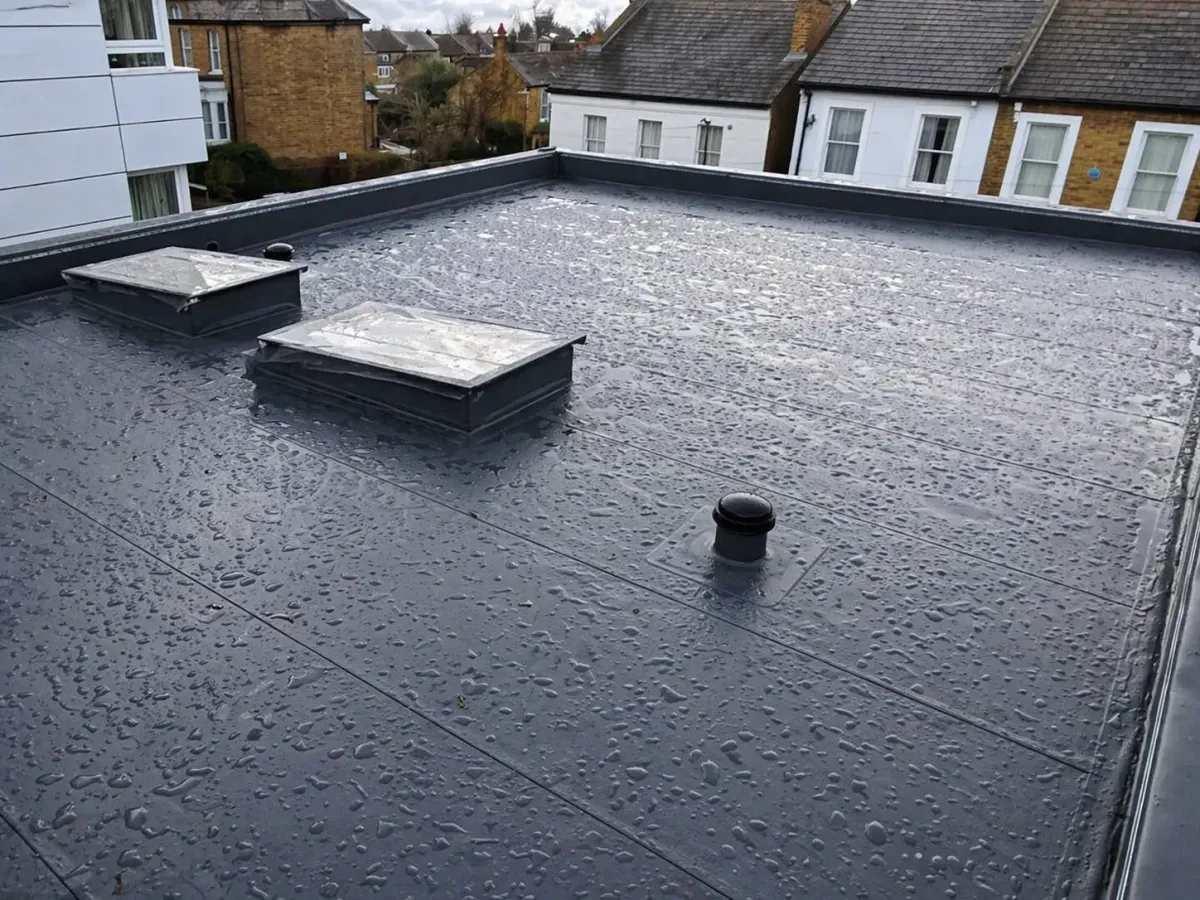
Single-ply membrane is built around a flexible waterproofing layer — typically TPO, PVC, or EPDM — mechanically fixed, adhered, or ballasted to the roof structure. It is lightweight, fast to install, and covers large areas efficiently.
Lifespan — most single-ply systems carry manufacturer warranties of 20–25 years. A well-installed roof on a correctly designed substrate will often last longer, but a replacement cycle within the life of the building should be anticipated.
Cost — single-ply is generally less expensive than metal on a like-for-like basis, in both materials and installation time. For projects where budget is the primary constraint, this matters.
Performance — single-ply performs well when the full specification is right. The membrane is only part of the picture: insulation, vapour control, drainage design, and detailing at upstands, penetrations, and perimeters all determine how the roof performs over time.
Appearance — membranes are available in a limited range of colours, typically grey, white, or green. The finish is functional rather than architectural. For most flat roofs that are not prominently visible this is not a significant factor; for extensions where the roof is part of the design, it may be.
Best suited to — extensions, garage roofs, commercial buildings, and replacement projects where programme time, weight, and budget are the primary considerations.
If single-ply is looking like the right fit, our single-ply flat roofing page explains the installation details, warranty expectations, drainage requirements, and typical applications in more depth. You can also browse our single-ply project gallery to see completed installations.
Metal flat roofing
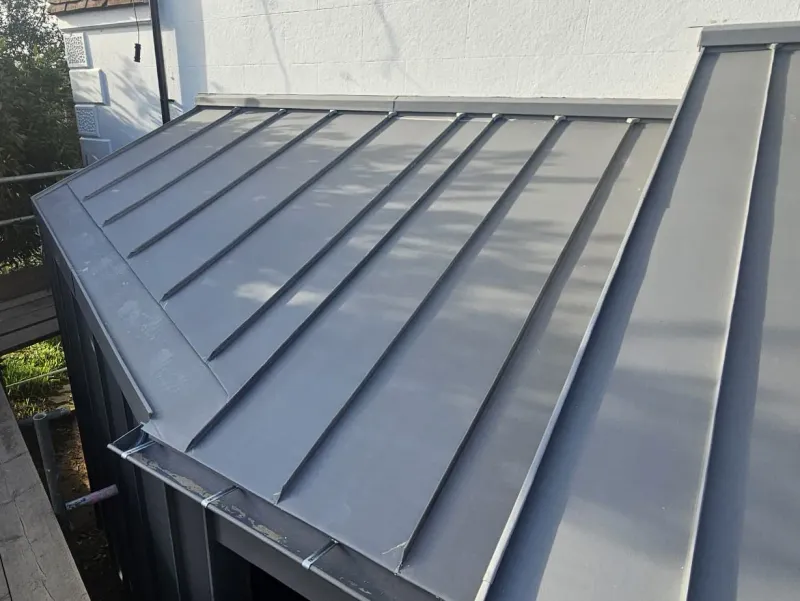
Metal flat roofing — most commonly standing seam zinc, aluminium, or copper on a fully supported deck — sits at the higher end of the performance spectrum. The system has no exposed fixings, weathers naturally, and has no finite service life in the conventional sense.
Lifespan — zinc and copper flat roofs are routinely specified with lifespans of 60–100 years. Aluminium performs similarly. There is no anticipated replacement cycle. Over a long enough horizon, the whole-life cost compares more favourably with cheaper alternatives than the upfront figures suggest.
Cost — metal costs more than single-ply, in both materials and the craft time required for installation. That premium is real. For a project where the roof will be replaced in 25 years anyway, it may be hard to justify. For a project built to last, the case is straightforward.
Performance — with no exposed fixings and a continuously locked panel system, metal flat roofing has very few points of potential failure. It accommodates thermal movement through concealed clips, is unaffected by UV degradation, and requires no coating renewals over its life. See our standing seam guide for a detailed breakdown of how the system works.
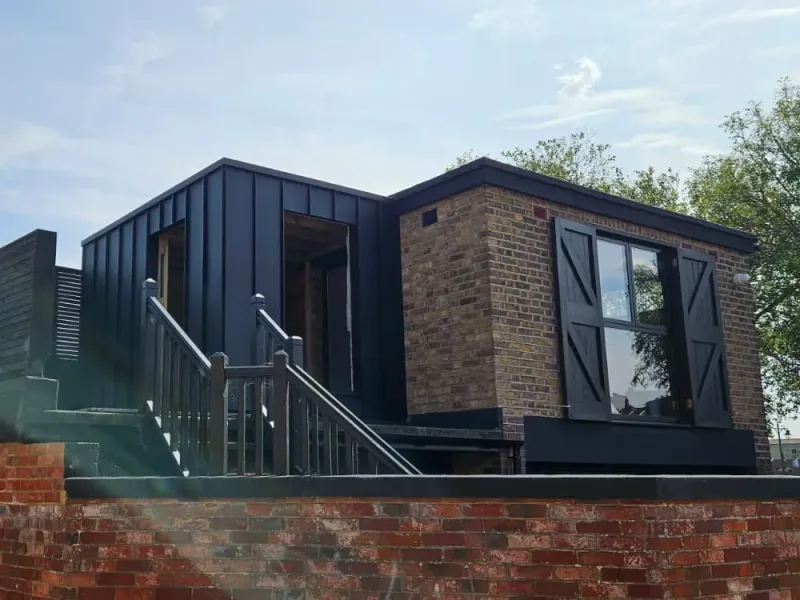
Appearance — metal has a precision and architectural quality that single-ply cannot match. On a contemporary extension where the roof is visible, or on a project where the external envelope is part of the design intent, this is a meaningful difference. Zinc and copper also develop a natural patina over time that gives the surface depth and character.
Best suited to — projects where longevity and appearance are priorities, architecturally prominent roofs, high-specification extensions, and owners who intend to hold the building for the long term.
How to decide
Four questions that clarify which system fits:
How visible is the roof? If it’s a rear extension only seen from the garden, appearance is secondary. If the roof is visible from the street, from upper floors, or is part of a design-led project, metal makes more sense.
How long will the building be owned — and by whom? A 25-year warranty system is a reasonable choice for a building that may be sold or significantly altered within that period. For a long-term owner who wants to avoid a future replacement project, metal is the better investment.
What’s the budget? Single-ply is the more cost-effective system upfront. If the budget is tight and the project is otherwise well-built, single-ply is a sound choice — not a compromise.
What’s the wider specification? Metal works best when integrated into the design from the outset — substrate, drainage, and detailing all designed around the system. For a straightforward like-for-like replacement on an existing structure, single-ply is often the more practical option.
If you’ve worked through these and want a view on which system suits your specific project, get in touch — we install both and can advise without a preference for one over the other.
For a broader view of pitch thresholds and low-pitch options, see our guide to metal roofing on flat roofs.
Getting the specification right
Whichever system you choose, the quality of the specification and installation matters more than the choice of membrane or metal. A single-ply roof with poor upstand detailing will fail. A metal roof on an inadequate substrate will perform below its potential. The full build-up — structure, insulation, vapour control, drainage, edge details, and the waterproofing layer — needs to be designed and installed as a coherent system.
We work on both single-ply and metal flat roofing across London and the South East. Get in touch to discuss your roof and we’ll tell you which system makes more sense for it.